The Anti-Violence Project (AVP)
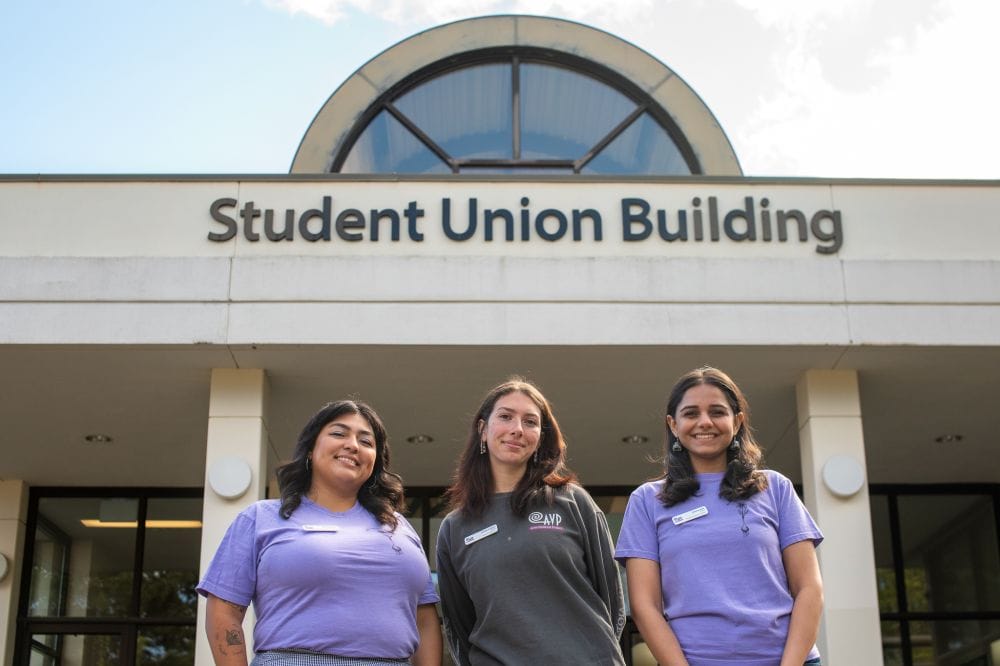
Left to right: Alessia, Peer Support and Administration Coordinator; Felicity, Operations Coordinator; Paloma, Education and Outreach coordinator.
Events
Learning & Teaching Innovation & Friends Fair
September 2 @ 11:00 am - 2:00 pmUVIC Residence Move in Fair
September 7 @ 11:00 am - 3:00 pmCampus Kick Off Tabling
September 9 @ 10:30 am - September 10 @ 4:00 pmMen’s Circle
September 10 @ 6:00 pm - 8:00 pmThunderFest
September 11 @ 11:00 am - 4:00 pmCommunity Care Circles: Goal Setting and Letters to Your Future Self
September 15 @ 4:30 pm - 6:00 pmCCU Days
September 16 @ 9:30 am - September 17 @ 4:00 pmMen’s Circle
September 17 @ 6:00 pm - 8:00 pm
Find Support
Asking for help is one of the hardest things to do. When you are asking for help about an issue that might feel really private, confusing and/or embarrassing, it is important to get support that is non-judgmental, without pressure, and informed.
Book a Workshop
AVP offers various workshops that can be customized to your group including: Consent, Supporting a Survivor Part 1 & 2, Bystander Training, Boundaries, Anti-Oppression and more.
AVP is your on-campus sexual assault resource centre, funded through student fees.
We provide peer-support, education, and advocacy on all interconnected forms of violence and specialize in sexualized and gender-based violence. We’re located at the University of Victoria under the Student Society (UVSS) located in the basement of the Student Union Building (SUB) B024 and B027.
Support hours
General Office Hours:
- Monday – Friday: 10:30-3:30pm
Peer Support Hours:
- Monday, Tuesday, Thursday, Friday :11am-3pm
- Wednesdays by appointment. Please email avppeersupport[at]uvss[dot]ca
Anonymous Support Hours
As of August 4th 2026, AVP will be offering Anonymous support hours twice a week. You can drop in anytime between the hours mentioned below to meet with one of our peer-support workers. For instructions on how to join please visit the “Support” tab.
Anonymous Support hours with:
Alessia: Tuesdays 2-4pm
Felicity: Thursdays 11am-1pm
Supporting a Survivor
Learn how to support friends and family that have experienced violence. At the Anti-Violence Project, we like to use the Listen-Believe-Refer-Care Model to support someone who has experienced sexualized or gender-based violence.
The Men’s Circle
The Men’s Circle at UVic aims to challenge gender-based violence and dominant constructions of masculinity. These gatherings are open to all men and masculine identified people (not just students!) so come and bring a friend or two!
Territorial Acknowledgement
The Anti-Violence Project lives, learns, and works on the Matoolia area, the unceded territories cəlíʔɬčə (Tsuli’lhchu); Čeqʷəŋín (Cheko’nein), čilq̓áʔwəč (Chilka’wuch); sxʷéŋxʷəŋ (Swenghwung); xʷsépsəm (Xwsepsum) of the lək̓ʷəŋən speaking peoples, and the Saanich territories of the W̱SÁNEĆ peoples.
We acknowledge that the lands we stand and nourish us today were, and are still made possible by the SXIMEȽEȽ (Esquimalt), Songhees, W̱JOȽEȽP (Tsartlip), W̱SIḴEM (Tseycum), BOḰEĆEN (Pauquachin), and Malahat nations who have historically tended these lands and continue to hold these relationships.
We believe that conversations on consent cannot be made without looking at Canada’s own ongoing legacy of occupying lands without consent; disrespecting existing territorial boundaries and treaties; and infringing on people’s bodies with violence and coercion, and believe that engaging in anti-colonial actions are critical to our work as anti-violence advocates.